Showing posts with label Lighting Effect. Show all posts

Monday, 14 May 2012

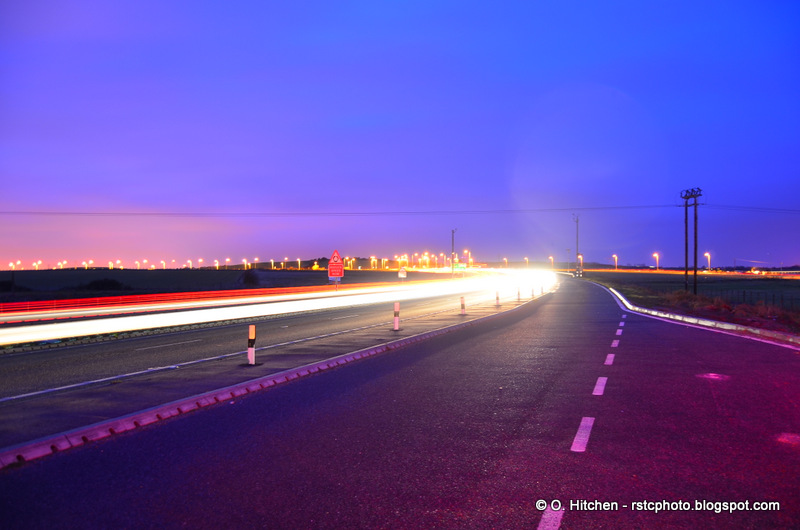
A249 Long Exposure

Photograph Details: Nikon D7000 Focal length 18mm ISO-100 exp: 30s f3.5

I know it's a road, and they are not exactly the most interesting places to be, especially at 0 mpg in a traffic jam, but I wanted to post this picture as I think the colours it contains are lovely! No post processing has gone into this one except for resizing and watermarking in Picasa


If you liked this post, or have done something similar, why not spend a minute and let me know in the comments at the bottom of the page


Or if you like this blog and would like to receive emails when it's updater why not subscribe. You will only get an email if there is a post on this blog, and your details will not be shared. Plus its free!
Simply enter your email address in the box below:


Email subscriptions are delivered by FeedBurner

As ever, thanks for reading

Monday, 30 April 2012

Light Flash

Photograph Details: Nikon D40 No further EXIF data available

If you like this blog why not subscribe by email.
Simply enter your email address:


Delivered by FeedBurner

Down The Tube

Photograph Details: Nikon D40 Focal length 70mm exp: 1/60 f5.6

If you like this blog why not subscribe by email.
Simply enter your email address:


Delivered by FeedBurner

Saturday, 25 February 2012

Abandoned boats, Dungeness

Dungeness is one seriously weird place. It's fantastic shingle beach is one of the largest in the world, and it has two nuclear power stations with one still active. Not just that but it's beach is pebbled with abandoned boats, beech huts, narrow-gauge railway tracks and the odd house crafted from old railway carriages. Not to mention the strange concrete "listening ears" - a precursor to modern day RADAR.

Friday, 24 February 2012

Dungeness Headland Lighthouse


Photograph Details: Nikon D7000 Focal length 18mm ISO-100 exp: 1/400 f11

Saturday, 11 February 2012

Warp Speed?


Photograph Details: Nikon D7000 Focal length 18mm ISO-100 exp: 209.6s f10

Wednesday, 2 November 2011

The Windmill, Parbold, Lancashire


On a trip back "Oop Norf" to see my family (and baby niece for the first time) I stopped off on the way back to my parents' house from my brother's to snap this shot. With no tripod, memory cards or camera charger the photography on the trip was rather underwhelming which was such a massive shame. 


The windmill sits on the Leeds-Liverpool canal, the longest canal in Northern England at 127 miles long, and it took 46 years to build (almost twice as long as I've been alive for) and at a cost of 5x the original budget! The idea for it was first proposed in 1765. The Canal Act passed in 1770 was for a route from Liverpool to Leeds via Parbold, Walton-le-Dale (just south of Preston), Colne and Skipton, with a branch from Burscough towards the River Ribble, a branch from Parbold to Wigan, a great aqueduct at Whalley and a branch from Shipley to Bradford. [Source]


I took this one with the camera propped on the door window sill of the car


Photograph Details: 
Nikon D7000
Focal length 18mm
ISO-100
exp: 25 sec
f3.5

Wednesday, 26 October 2011

Diwali - Festival Of Lights


Today is the start of the Festival of Lights (know as Diwali, Deepawali or Devali). This is an important festival in HinduismJainism, and Sikhism, celebrated for different reasons, occurring between mid-October and mid-November and is lasts for five days. For Hindus, Diwali is one of the most important festivals of the year and is celebrated in families by performing traditional activities together in their homes. For Jains, Diwali marks the attainment of moksha or nirvana by Mahavira in 527 BC. For Sikhs, Diwali is celebrated as Bandhi Chhor Diwas (The Celebration of Freedom), and celebrates the release from prison of the sixth guru, Guru Hargobind, who also rescued 52 Hindu kings held captive by Mughal Emperor with him in the Gwalior Fort in 1619.

Deepavali is an official holiday in IndiaNepalSri LankaMyanmarMauritiusGuyanaTrinidad & TobagoSurinameMalaysiaSingapore, and Fiji.
The name "Diwali" is a contraction of "Deepavali" (Sanskritदीपावली Dīpāvalī), which translates into "row of lamps". Diwali involves the lighting of small clay lamps (diyas or dīpas) in Sanskritदीप) filled with oil to signify the triumph of good over evil. During Diwali, all the celebrants wear new clothes and share sweets and snacks with family members and friends.
Diwali commemorates the return of Lord Rama, along with Sita and Lakshmana, from his 14-year-long exile and vanquishing the demon-king Ravana. In joyous celebration of the return of their king, the people of Ayodhya, the Capital of Rama, illuminated the kingdom with earthen diyas and by bursting firecrackers.
The festival starts with Dhanteras on which most Indian business communities begin their financial year. The second day of the festival, Naraka Chaturdasi, marks the vanquishing of the demon Naraka by Lord Krishna and his wife Satyabhama.Amavasya, the third day of Deepawali, marks the worship of Lakshmi, the goddess of wealth in her most benevolent mood, fulfilling the wishes of her devotees. Amavasya also tells the story of Lord Vishnu, who in his dwarf incarnation vanquished the Bali, and banished him to Patala. It is on the fourth day of Deepawali, Kartika Shudda Padyami, that Bali went to patala and took the reins of his new kingdom in there. The fifth day is referred to as Yama Dvitiya (also called Bhai Dooj), and on this day sisters invite their brothers to their homes.
Besides Hindus, Sikhs and Jains also celebrate Diwali.

Tuesday, 18 October 2011

Evening Lights


Here is a photo I got with my new Nikon D7000 the other night when I was messing about with the white balance settings. Just for the sake of it I popped it into Photoshop and ran the auto colour correction but I was disappointed with the results - they came out fairly boring - so I decided to keep and post this one, it's much more dramatic.

Photograph Details:

  • Nikon D7000
  • focal length 18mm
  • ISO-100
  • exp: 1/10
  • f3.5

Thursday, 13 October 2011

Nail


In woodworking and construction, a nail is a pin-shaped, sharp object of hard metal or alloy used as a fastener. Formerly wrought iron, today's nails are typically made of steel, often dipped or coated to prevent corrosion in harsh conditions or improve adhesion. Ordinary nails for wood are usually of a soft, low-carbon or "mild" steel (about 0.1% carbon, the rest iron and perhaps a trace of silicon or manganese). Nails for concrete are harder, with 0.5-0.75% carbon.

Saturday, 1 October 2011

Thursday, 29 September 2011

Fish Eye Milky Way


The Greek philosopher Democritus (450–370 BC) proposed that the bright band on the night sky known as the Milky Way might consist of distant stars. Aristotle (384–322 BC), however, believed the Milky Way to be caused by "the ignition of the fiery exhalation of some stars which were large, numerous and close together" and that the "ignition takes place in the upper part of the atmosphere, in the region of the world which is continuous with the heavenly motions." The Neoplatonist philosopher Olympiodorus the Younger (c. 495–570 AD) criticized this view, arguing that if the Milky Way were sublunary it should appear different at different times and places on the Earth, and that it should have parallax, which it does not. In his view, the Milky Way was celestial. This idea would be influential later in the Islamic world.

Thursday, 8 September 2011

Milky Way

One of the main reasons I have not been blogging recently is that I've taken what was once a feint affinity for the stars to a new level. I purchased a small telescope and started looking at astrophotography in a whole new way.

Monday, 21 June 2010

Rickety Wooden Garden Fence


A fence is a freestanding structure designed to restrict or prevent movement across a boundary. It is generally distinguished from a wall by the lightness of its construction: a wall is usually restricted to such barriers made from solid brick or concrete, blocking vision as well as passage (though the definitions overlap somewhat).

Thursday, 17 June 2010

Sugar Plum Fairy


Photograph Details: Nikon D40, focal length 55mm, ISO-200, exp: 1/800sec, f-stop 14

Sunday, 8 November 2009

Sheppey Rugby Club Fireworks Display, 7th Nov 2009


A firework is a low explosive pyrotechnic device used primarily for aesthetic and entertainment purposes. The most common use of a firework is as part of a fireworks display. A fireworks event (also called a fireworks show or pyrotechnics) is a display of the effects produced by firework devices. Fireworks competitions are also regularly held at a number of places. Fireworks (devices) take many forms to produce the four primary effects: noise, light, smoke, and floating materials (confetti for example). They may be designed to burn with coloured flames and sparks including red, orange, yellow, green, blue, purple, and silver. Displays are common throughout the world and are the focal point of many cultural and religious celebrations.

Monday, 13 July 2009

I’m a Firestarter, twisted firestarter


A flame is a mixture of reacting gases and solids emitting visible and infrared light, the frequency spectrum of which depends on the chemical composition of the burning material and intermediate reaction products. In many cases, such as the burning of organic matter, for example wood, or the incompletecombustion of gas, incandescent solid particles called soot produce the familiar red-orange glow of 'fire'. This light has a continuous spectrum. Complete combustion of gas has a dim blue color due to the emission of single-wavelength radiation from various electron transitions in the excited molecules formed in the flame. Usually oxygen is involved, but hydrogen burning in chlorine also produces a flame, producing hydrogen chloride (HCl). Other possible combinations producing flames, amongst many more, are fluorine and hydrogen, and hydrazine and nitrogen tetroxide.

Monday, 23 February 2009

Stunning Sunset

Firstly, let me apologise for the lack of posting for the last ten days or so. Last week was half term, so I went home but my laptop's power supply failed and I've essentially been without a computer for a while now. Anyway, I've borrowed my mums until mine is fixed. On the downside, I have few photographs on here.

Friday, 9 January 2009

Stained Glass

The sight of coloured bottles are commonplace in society today. Most wine bottles are green (as is this one), some ale bottles are brown, and Bombay Saffire bottles are stained blue. In fact you can stain glass almost any colour you want and there are various methods which can be employed to achieve this but where has it come from?

Coloured glass has been produced since ancient times. Both the Egyptians and the Romans excelled at the manufacture of small coloured glass objects. The British Museum holds two of the finest Roman pieces, the Lycurgus Cup, which is a murky mustard colour but glows purple-red to transmitted light, and the Portland vase which is midnight blue, with a carved white overlay.

Amazon Adverts

Amazon Adverts

Subscribe via email

Enter your email address:

Delivered by FeedBurner